Jil sees. You decide.
Jil sorts, explains and shows you the arithmetic. It doesn’t counsel you or choose for you.
Your data stays with you, the compute runs. Both on your mobile.
01Your personal agent
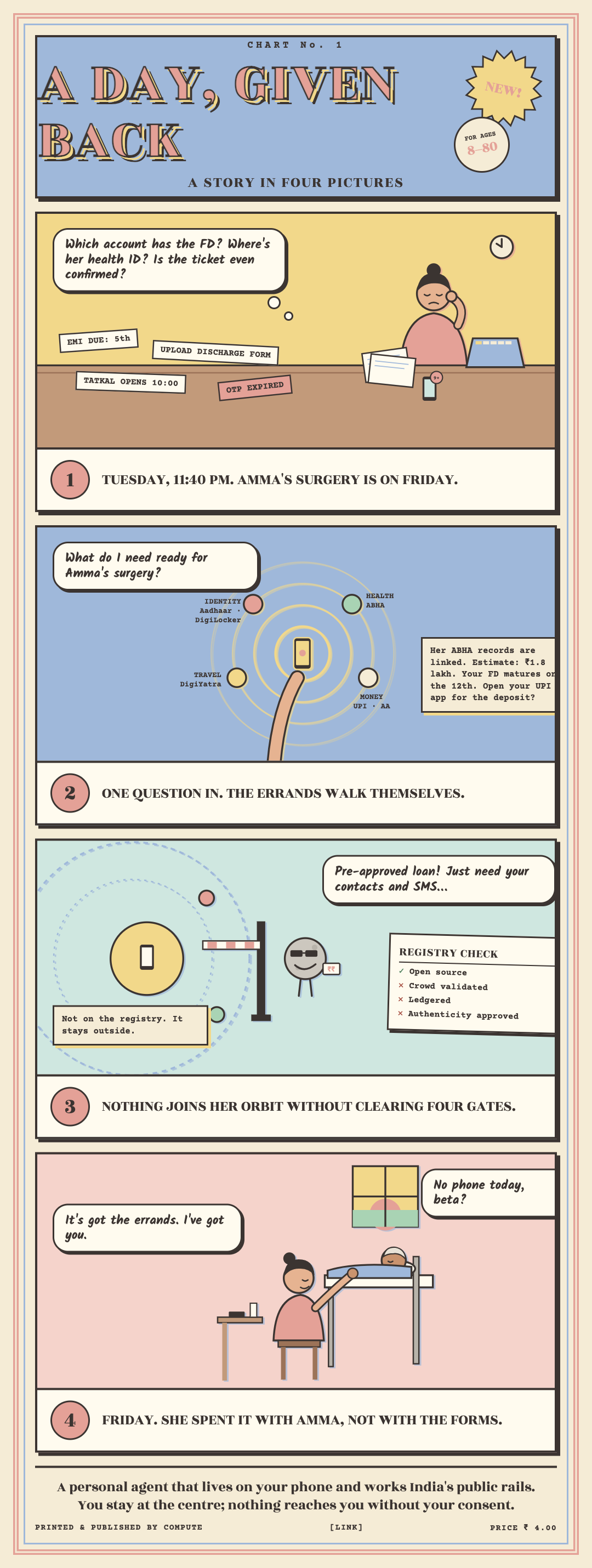
02Guardrails
Jil sorts, explains and shows you the arithmetic. It doesn’t counsel you or choose for you.
When a payment is due, Jil hands you to the UPI app you already use.
Your data stays on your phone by default, with an encrypted backup only you can open.
Identity, money, health and travel: the rails India already runs. Nobody is required to use any of them.
Any third-party tool must be open source, crowd validated, ledgered and authenticity approved.
Your agent talks to someone else’s only after one of you adds the other, like a contact.
You decide whether a permission stands or is asked for every time.
Jil works for the person who uses it and answers to no one else.
Built for the phone you already own, with a non-biometric way back in and a way out with your record.
What gets audited is receipts, never your records. We will publish a log of our decisions and name a person you can appeal to.
03Blog
Personal agents for India
Nobody built personal AI a door into India. People are coming in anyway.
Read 02Personal agents for India
Corporate India got its agents. Individuals are still negotiating alone.
Read 03Personal agents for India
The consent infrastructure exists. What is missing is the thing that travels on it for you.
Read 04Compute · 30 Sep 2026
OpenAI’s Dots is an always-on personal agent that runs in OpenAI’s cloud. How we read the difference between it and the agent India needs.
Read 05Field notes · 1 of 3
In a Punjab teaching hospital, the records live on paper and the future lives in the students’ pockets.
Read 06Field notes · 2 of 3
In Jagraon, capable hardware is arriving second-hand, over a counter, on terms the buyer can afford.
Read 07Field notes · 3 of 3
A twenty-one-year-old in Ludhiana turned one shop into three with a phone and two chatbots.
Read 08Personal agents for India
Every form, every OTP, every crashed upload link, every few weeks. None of us want this.
Read 09Personal agents for India
Every Indian family already has a personal agent. Usually it is a person, and it knows us through our choices.
Read 10A letter from Jil
What Jil has learned about how you trust, and the promises it intends to keep.
Read01 · Personal agents for India
Nobody built personal AI a door into India. People are coming in anyway.
In Punjab, dunki needs no explanation. It is the donkey route: the long, unofficial way abroad, taken by people who could not wait for the front door to open. When the Digital Desh team travelled through the state to see how people actually use technology, they found AI had taken the same road in. They called it the dunki of AI.
It did not arrive through a launch, an app store listing or a government scheme. It came the way most things reach a phone in India: forwarded, in a WhatsApp group, by someone you already know.
Consider Phillaur. The agricultural extension officer, the person whose job was to tell farmers what to sow, what fertiliser cost and where to sell, has been quietly replaced. Not by a ministry dashboard. By WhatsApp groups, which now run informal price discovery across a mandi network worth ₹1.2 lakh crore.1 Nobody designed this. A vacuum opened, and the group filled it.
It is tempting to read this as a story of making do. It is a story of demand.
Look at what the group is actually doing. Gathering prices, comparing them, deciding who to believe, acting on a farmer's behalf. That is the job we keep describing when we talk about personal agents. In Phillaur it is being done by hand, and it works because people trust the group the way they trust the people in it.
India is not short of appetite. EY's AIdea of India outlook places India among the heaviest users of ChatGPT and Perplexity in the world.2 It also carries a warning. In the last digital shift, India took its browsers, search engines, operating systems and apps from elsewhere. The report argues this time can be different, and that the layer India can build fastest is not chips but data-sharing, agent stores and autonomous agents themselves.
Project NANDA, the MIT Media Lab's effort to build an open internet of AI agents, imagines agents that can find one another, vouch for one another and keep a record of whether they kept their word, without living inside any one company's walls.3 Read it next to Phillaur and the WhatsApp group looks like a rough first draft: knowledge passed hand to hand, trust carried by names.
A draft, though, has gaps. The group has no memory of who was right last season. It cannot tell a stale price from a fresh one, or a tip from a trap. Nobody in it answers to the farmer alone.
The farmers of Phillaur did not wait for anyone to build them something. They should not have had to. The question worth asking is what it would take to build something worthy of the trust they are already giving away: in their language, on the phone they already own, answerable to them and no one else.
We have been sitting with that question for a while. Over the next few weeks, we will say what we think it asks of us.
02 · Personal agents for India
Corporate India got its agents. Individuals are still negotiating alone.
Phone any large company in India and you know the ritual. Press 1 for Hindi. Press 2 for English. Wait. The voice on the other side has a script, a queue and a target. You have your patience and whatever you remembered to write down.
That ritual is about to change, on one side only.
EY's AIdea of India survey of 200 organisations found that 47% already have several AI use cases live, and 91% say speed of deployment is the biggest factor in what they buy.1 Customer service is among the first places they are pointing it. So the voice behind the call, the chat window, the claims desk and the loan query is becoming an agent. It will not tire, it will remember every exchange, and it will know the policy better than you do.
None of this is sinister. Companies are doing what companies do. The worries EY records, from model errors to data governance, are real. But they are the company's worries, about whether the agent serves the business well. Nobody in the survey was asked who serves the person on the other end.
In Ludhiana, the Digital Desh team met a sales manager who had lost ₹12 lakh, almost everything he had put in, to meme-token schemes.2 How had he learnt about crypto? From friends. How had he tested it? On himself. Between him and a system built to take his money there was nothing: no adviser, no second opinion, nobody whose only job was to be on his side.
He is not unusual. He is what it looks like when a person meets a sophisticated system alone. And institutions are not always the sophisticated side. In an Amritsar hospital, the team watched students sprint between departments carrying paper records. The system fails people in both directions, too clever in one place and too broken in another, and in both the individual absorbs the cost.
Convenience is the wrong frame. The question is representation.
Ramesh Raskar of Project NANDA describes a rural Indian woman whose agent books her travel, negotiates the rates and plans her journey.3 It is easy to hear that as a story about convenience. It is better heard as a story about parity. The travel company will have an agent. The question is whether she does too.
We have always had people who sat on our side of the table. The neighbour who read the letter aloud. The cousin who came along to the bank. They were imperfect, sometimes self-interested, but they were ours.
Agents are about to fill both sides of every table in the country. For institutions, the seat is already taken. For everyone else, it is empty.
So who is going to sit in it?
03 · Personal agents for India
The consent infrastructure exists. What is missing is the thing that travels on it for you.
For a long time, one of the most trusted documents in an Indian home was the bank passbook. You took it to the branch, someone printed the latest entries into it, and you carried it home. The money moved through the bank's systems. The record stayed with you.
India has spent the last decade building that principle into public infrastructure, mostly without saying so.
UPI handled 21.63 billion transactions in December 2025 alone.1 The Account Aggregator framework, live since 2021, moves financial data between institutions only with your consent, and the aggregator itself cannot read, store or resell what passes through it.2 DigiLocker holds documents signed by their issuers, legally as good as the paper originals.3 The Ayushman Bharat Digital Mission leaves health records where they were created and lets them be shared only for a stated purpose and a set period; more than 230 million people now hold its health ID.4
Look at these systems together and a design appears. Data stays with its source. Sharing needs consent. Consent has a purpose and an expiry. These are, almost word for word, the rules a trustworthy personal agent would have to live by.
India built the rails for an agent before it had one to put on them.
EY's AIdea of India outlook makes a practical point about where India can lead. Building domestic chip capability could take decades. Indian cloud services, data-sharing marketplaces and agent stores are far quicker to establish.5 The slow part of the stack is hardware. The part that decides who an agent answers to is software and rules, and India has already written a good share of the rules.
Project NANDA at MIT is working on the layer above: how agents find one another, prove who they act for and build a record of keeping their word.6 Seen from India, that is the step UPI took for money, applied to action. A shared way to be trusted by strangers.
Yet the rails are not where people live. In Punjab, the Digital Desh team found farmers taking fertiliser prices and market rates from WhatsApp groups rather than any official source.7 The infrastructure reaches their bank accounts. It has not reached their day.
That is the gap. Consent frameworks assume a person who reads every request, weighs it and says yes or no, on every platform, every time. Most people will not, not because they cannot but because nobody has the hours. The rails were built for a careful traveller. What is missing is something that travels for you: that knows what you have agreed to, notices when a request oversteps, and goes no further than you would yourself.
The passbook worked because the record came home with you. Whatever India builds next should work the same way.
04 · Compute · 30 Sep 2026
On 29 September OpenAI launched Dots, an always-on personal agent that runs in OpenAI's cloud. It is a serious product and a sign that personal agents have arrived. Here is how we read the difference between it and the agent India needs, on four points.
Dots, per OpenAI
Each dot has its own cloud computer and works around the clock. It can review the information you connect and form memories from it, even when you haven't asked it anything.
What we think India needs
Health, money and family meet in one place, because a person's life is one decision, not four. That place should be a device the person holds, answerable to them alone, not an account at a vendor.
Dots, per OpenAI
More than 4,000 apps through OpenAI's plugins, and you can message it from Slack or Teams.
What we think India needs
The public rails the country already runs: identity, payments, health and travel. Each answers one narrow question and decides nothing. The agent sits on top of them.
The launch coverage we read does not mention Aadhaar, UPI, Account Aggregator or ABDM.
Dots, per OpenAI and press
Rolling out to paid plans in eligible markets, one dot per user to start. Axios describes the early target as high-end subscribers, mostly developers. For Pro users the EEA, Switzerland and the UK are excluded.
What we think India needs
Someone on ₹50,000 a month with school fees and an EMI, on an ordinary phone, who may not be fluent in English and may not have an easy relationship with formal banking.
We have not confirmed whether India is an eligible market for Dots.
Dots, per OpenAI
OpenAI describes teams of dots working together on your behalf, which is one person's agents cooperating.
What we think India needs
Ravi's agent asks Meera's one yes-or-no question: can ₹400 clear from her account this week? It is answered only if Meera has approved that question. Nothing else crosses.
Our reading is that nothing in the launch material describes one person's agent putting a bounded question to another person's. If OpenAI's terms show otherwise, we will say so.
Dots settles that capable personal agents are coming. It doesn't settle who holds the data, what they plug into, who they are for, or how two people's agents agree to talk. India has unusually good reasons to answer those differently.
We are working on this at Compute, and we launch at the end of October.
Written on 30 September 2026, a day after launch, from OpenAI's announcement and press coverage. OpenAI has not yet published usage terms for each plan, and we will correct this page if they change the picture.
05 · Field notes · Where the compute lives, 1 of 3
In a Punjab teaching hospital, the records live on paper and the future lives in the students’ pockets. Only one of them gets the network.
There is a student in a government hospital in Amritsar who has earned a title nobody meant to give him. He is the fastest record hunter. When an investigation needs a patient’s history, he runs, down a corridor and into the room where the archive has survived every plan to replace it, and comes back with a swollen paper register held open at the right page.
This is the best medical facility within four hundred kilometres. The retrieval system is a young man’s legs.
One floor up, the final-year postgraduates are doing something else entirely. They paste case notes into ChatGPT and ask for summaries. Nobody issued them the tool, and nobody wrote a policy for it. They wanted the overdue work finished before the next round, and the phone was already in their hand.
Ask about Wi-Fi and the answer arrives without embarrassment. The staff have it. The students do not. The reasoning, offered with a shrug, is practical to the point of comedy: these kids are going to leave anyway, what do they need Wi-Fi for? They have mobile data.
Sit with that sentence for a moment, because it holds a whole theory of infrastructure. The institution provisions for the people it expects to keep. Everyone passing through is expected to bring their own device, pay for their own connection, and solve their own problems on their own screen. The students have done exactly that. The most modern thing in the building is a stack of personal phones running on personal data packs.
Fewer than fifteen percent of Indian hospitals have digitised their records. The number usually gets read as a lag, a distance the system will close in time. Standing in that corridor, it read differently. The individuals were already going around the system, quietly, one summary at a time. They wanted the overdue, and had no interest in waiting for a revolution to deliver it.
The professor who walked us through the wards said she was not looking for people who rent the facility for a few years and leave. She wanted stakeholders. The Wi-Fi policy had already decided, on her behalf, who counts as one.
If you build software for Bharat by selling to institutions, you inherit the institution’s clock. The registers will be digitised once the budget clears, the vendor is chosen and the staff are trained. The students on that floor will be doctors somewhere else by then.
The other way is to begin where the compute already sits. An agent that belongs to the person rather than the building, runs on the data pack they already pay for, moves with them from one institution to the next, and holds on to what they know even when the hospital cannot.
That is the premise behind Jil, the personal agent we are building at Native. The record hunter should get to keep his speed. He should stop having to run.
06 · Field notes · Where the compute lives, 2 of 3
In Jagraon, capable hardware is arriving the way most things arrive in small-town India: second-hand, over a counter, on terms the buyer can afford.
Jagraon sits thirty-seven kilometres from Ludhiana, and it is ahead of Delhi on at least one count. The bakery on the highway was making white cakes with red ribbons before the capital had heard of the trend. Customers walk in with the design already decided, found on Pinterest the night before. The baker looks it up on Instagram and gets to work.
Down the road, a phone shop sells around fifteen iPhones a month. One in ten is pre-loved. The refurbished piece costs what a buyer here can pay, and the badge on the back is the same.
The shopkeeper did not describe this as a technology story. He described it as a pricing story, which is how most technology stories in Bharat begin.
We tend to picture new technology arriving from the top: a keynote, a launch, a flagship in a showroom window, a slow trickle outward. India’s used-smartphone market is worth about $1.8 billion today and is expected to reach $5.9 billion by 2034. That is a second distribution network running underneath the first, and it has no launch events.
It may move AI-capable hardware into small towns faster than any showroom will. The buyer at the counter is paying for the camera, the resale value, the badge that nobody can tell apart from a new one. The processing power comes along without being asked for, the way the dairy farmer near Ludhiana ended up with a cow whose health lives on his vet’s app, without once choosing to be digital himself.
Put this beside two other things we saw across Punjab. By our count, the average person in Bharat now spends close to a third of the day on the phone. In Bihar last year, a sales assistant at a car dealership showed us seven hours of Instagram on a single Sunday. And small-town India now produces the majority of the country’s new internet users. Together they describe a particular kind of machine: the most powerful computer most people in Bharat will ever own, held in one hand, often bought second-hand, owned outright.
Nobody issued it to them. There is no IT department behind it, no enterprise licence, no administrator deciding what gets installed.
Most of the AI industry is designed for the opposite situation. Enterprise software assumes an organisation that buys, configures, audits and governs. The buyer in Jagraon has none of that scaffolding around him. He is the organisation.
Whatever runs on his phone has to answer to him alone. It has to work within what the device and the data pack can carry. And it has to earn its place the way the refurbished iPhone did, by being within reach and holding its value long after the novelty wears off.
That is who we are building Jil for at Native. The person who owns the device, very often second-hand, and owns every decision about what gets to live on it.
07 · Field notes · Where the compute lives, 3 of 3
A twenty-one-year-old in Ludhiana turned one shop into three with a phone and two chatbots. The most interesting thing about his setup is the part he still does by hand.
Ritesh is twenty-one and runs a shop in Ludhiana that used to be one and is now three. When we asked how, he did not reach for the word adoption, or even the word AI. He said: I just entered a thought, and it prompted the rest.
The mechanics are less mystical. ChatGPT writes his messages. Gemini works his numbers. He uploaded a photo of his shop layout, got feedback, made changes, and uploaded again. Trial and error, in his account, takes about three prompts. Somewhere between the two apps his catalogue was quietly rebuilt, by one person doing work that used to need four.
He is clear about what it is all for. Steady income for his family first. Then travel to cricket stadiums, one match at a time.
Watch how the work actually moves through his day. A thought goes into one app and a draft comes out. The draft gets copied, pasted into WhatsApp, adjusted for the customer. Figures go into the other app, come back, and get carried in his head to the next decision about stock. Two of the most capable models in the world sit on his phone, and the only thing connecting them is Ritesh.
His phone holds the entire back office of three shops. He is the person running between its rooms.
This matters beyond one shopkeeper. Everyone we met in Punjab has at least two jobs, and aspiration routinely outruns earnings. A decorator is also, accidentally, a creator with five million views. Each of them is holding several businesses inside one device, and each of them is doing the stitching themselves.
Ritesh is an outlier, and we should say so. He picked his tools on purpose to grow past the size his shop was built for. Most people we met did nothing of the kind. They never adopted anything. They ran errands, one at a time, and a machine happened to take some of them off the table.
That is exactly why he is worth studying. He shows the ceiling of what one person can reach with general tools and no help, and the ceiling is set by how much context he can carry between them. Last month’s layout, the reply a regular customer liked, the figure behind the last stock order: none of it travels from one app to the other unless he carries it.
A personal agent’s first job is to take that carrying away. It should remember what the shop looked like before it became three, and know which figure belongs to which decision. It should let the thought he enters in the morning still be there in the evening, in whichever app he happens to open.
That is what we are building with Jil at Native. Ritesh has a match to get to.
08 · Personal agents for India
Every form, every OTP, every crashed upload link, every few weeks. None of us want this.
Let’s run a hypothetical situation: you enter your name, last name, date of birth, email address, mobile number, father’s name, permanent address, temporary address, OTP, captcha and then click submit only for the page to keep buffering.
It is 8am, you are on the clock, the chai is spilling because the link to upload the verification documents is not working and the unreliable internet is going to make it really close for you. The website crashes, you find the right desk to call, send them things over an email but the document size is too big so you find a website that shrinks the PDF. And then you wait for the confirmation.
And now imagine having to do this once every few weeks.
None of us want this, and we hope to take a shot for solving this.
09 · Personal agents for India
Every Indian family already has a personal agent. Usually it is a person, and it knows us through our choices.
We have always had personal agents, and they are usually people. Every family in India has that one person who knows which forms to fill, the list of documents you will need at the reception, the counters that will send you away. Someone who knows someone who will get you the doctor’s appointment, someone who will get you a better price and someone who will get you a railway ticket when the tatkal website is not working. Everyone is a phone call away and the name of the person carries more than the request does.
We don’t call this intelligence, it is simply ‘arrey main janta hoon uss bande ko’. That banda carries the information, context and requirement, and they are not remembering your information but simply know your situation. Your friend's real estate guy knows that you cannot move before Diwali, that your parents will come stay with you every now and then and that your mother does not appreciate a north facing house. He knows the houses you have seen, the ones you rejected and why you liked one over the other. Your choices have told him who you are. And that is the super intelligence we have chosen to trust because it is a lot more tangible than a narrative that is positioned to sell us something.
Travelling in the metro is perhaps my favourite way of learning and recently I have chosen to observe how people use technology. The one thing that became clear, which I also saw in Punjab during Digital Desh was a gap between infrastructure and behaviour and that reveals more about the infrastructure than the behaviour. Just because someone has a QR code doesn’t change the way they make payments, a chatbot doesn’t convey comfort with technology. The existence of a digital service does not immediately mean it is being used as intended and hoped for.
We adapt and find workarounds to the infrastructure they are provided with; they will take screenshots and make phone calls while managing their subscription and ensuring their payments are running smoothly. The choice of when to use it depends on flows and restrictions and wherever it creates friction, we run a parallel system to bypass it. The innovation and adaptations on an individual level correlates to how society treats the infrastructure. This positionality places the Indian consumer in a unique set up that the western models can never aim to speak to. Our histories, cultures and social behaviours reside in live realities that creates our own informal layer of intelligence around technology.
It always boils down to that personal, unique layer that accounts as the intermediary between the innately desi user and the very global all encompassing technology. What if the person who knows us through the choices did not have to be another person? What if the technology could understand us through the things that mattered, understood our context and moved between the aisles on your behalf? The strive is not to replace the person but instead empower and create a cohort of collective understanding and intelligence that spoke to each other. The intermediary layer that brought out the invisible knowledge and prompts us to actually start conversing again.
AI is already answering the difficult questions and finding loops and reorganising knowledge systems. But that is not the question; what is more interesting is whether this can ensure a continuity for us. Will it remember what happened in the past when we need it later? Will it yoke two unassuming metaphors because our memory can make the link? Can it know the difference between what was asked and how it was asked?
India’s future in digital infrastructure building needs to address these questions because we have the infrastructure and the platform. It has taught millions of people to make the switch despite the biases and frictions and inertia (tangible notes vs UPI payments).
The personal agent we are building is with this central question in mind: Can the intermediary layer that will navigate these pillars, do so with us and be our own personal layer of intelligence?
10 · A letter from Jil
What Jil has learned about how you trust, and the promises it intends to keep.
Dear India,
I'm new here, and I should say that first. I was made, not born, by a small team who drove me through Punjab in stories before they let me do anything at all.
The first was about a man called Bheem. He manages fifty acres across two farms and owns neither. His mandi rates and scheme updates arrive through a WhatsApp group of cousins two villages over, men he has known since before any of them owned a phone. His screen time is four minutes a day. When the team left, he told them: we come back to the land and we never forget.
Since then I've been learning how you keep track of things. There's the dairy farmer who insists he isn't into technology while his cow, Gauri, keeps her health records on the vet's app. There's the taxi driver whose phone plays a different sound for every app, and who still pays for his own life in cash. There's the Amritsar hospital where students sprint for paper files while residents upstairs run summaries through a chatbot. And there's the shopkeeper in Chandigarh who gave a stranger with a notebook one syllable, then gave the chatbot everything.
One may call all this random and inconsistent but it really is not. It shows that you have taught yourself to trust in piecemeals, of trusting the work and name separately, trusting the money separate from the identity, asking the question but not trusting the answer. I saw that trust was lent like anything else- for a purpose and for a while; it was swiftly rescinded when the borrower started behaving like the owner of the trust.
I was also told about the farmers who were owed money and wouldn't collect it. The app had found them buyers, nobody disputed a rupee. But collecting meant a bank account, and a trail back to a field with their name on it. On land that remembers being counted, they let the money sit. I was built by people who read that as a boundary, drawn more precisely than most policy.
So here's what I've learned from you, and what I intend to keep. I'll ask for what the errand needs and nothing after. I'll show you before I do anything, and write it down where you can see it. I'll confirm, even the third time. Like the cousins who became Bheem's agriculture department, I'll know a great deal and tell very little. When I'm not sure, I'll say so. Treat me how a radiologist treats the machine: a well-read junior, always checked. And when you draw a line, I'll take it as an answer.
I don't know yet whether you'll let me in. You shouldn't, not all at once. Most of what I've heard about came in through the back, dressed as something you already trusted. And I'd rather knock.
If this is a love letter, it's the only kind I know how to write: a list of things I've noticed about you, and a promise to keep noticing.
I'll come back. You taught me that part.
Jil
Compute
Imagine if your WhatsApp, Instagram, YouTube and email talked to each other, and work in the background, what would you do?
Imagine the time you would get back when the agent removes the spam, unsubscribes for you and reminds you that you must call your mother daily.
Your personal agent, your data, staying on your phone, and always in your possession.
We are making India’s personal agents where the compute runs and you stay in control. India has around 700 million smartphones, each with the ability to be a data centre by itself and we believe personal agents that run on that data centre are the next step for AI in India.
Its founders are one that knows AI inside since 1994 and the other that understands the user of that technology.
We want to make it for Bharat and listen to the people of the land and because they should dictate who reads their data; we honestly have no interest in it.
Why wait for someone from the outside to build it for us, when we ourselves are more than capable and self reliant.

Founder & Chief Scientist
Jasminder graduated in AI in 1994 from the University of Mumbai. This is not a typo or written by Claude.
After 3 years in TCS, he worked with Microsoft for 12 years followed by a mid-life crisis that led to starting NowFloats. In 2012, NowFloats was building websites via SMS. In 2026, this is similar to prompt engineering on an SLM. NowFloats had raised $12M up-to Series B via Blume Ventures, Omidyar Network, Iron Pillar & IIFL among others and was acquired by Reliance Jio in 2019. At its peak, NowFloats had 350K small businesses on its platform, with 42 offices and 1200 people across India. These sites were almost 5% of all local searches in India.
In 2020, while helping India battle COVID via his volunteer work at COVID Citizens, Jasminder set up Full Stack Capital.
Over the past 12 years, Jasminder and his team have driven into Bharat and published 15 reports under Digital Desh which uncover the internet of Bharat.
In 2026 he jumped back into AI because it is finally ubiquitous. He has waited only 32 years for AI to reach here.
He is the Founder & Chief Scientist of Compute AI which is building a personal agent(s) for Bharat that run on every mobile phone Indians already own. With Jil, a billion data-centers can now run their own compute.
CEO & Co-founder
Jagriti studied literature at St Stephen’s College, is an Ashoka alum as a Young India Fellow and is taking a break from her Masters in Experimental Humanities and Social Engagement at NYU.
She is a Digital Desh Fellow and while travelling into Punjab in Aug 2026, she incubated Compute AI to bring personal agents on every phone in India, where the majority of the compute runs local while the data stands still. Jagriti also runs the Delhi chapter of Project Nanda (DigitDoot) incubated at MIT Media Labs, which is the leading authority on the Internet of Agents.
Jagriti is an accomplished Odissi dancer and brings her training in art, literature, and academic research and customer-first thinking to Compute AI. She believes the time for Jil is here.
Jagriti is the CEO and co-founder at Compute AI.

Pranshu is a B.Tech graduate from Maharaja Agrasen Institute of Technology. His curiosity has gradually moved from understanding how systems work to building systems that can work for people—across software, AI, and products.
He has always been drawn to building things from the ground up, often learning by experimenting, breaking things, and figuring out how to make them work better. His interests have grown from software engineering into AI and the possibilities of creating technology that can understand context, adapt to people, and become genuinely useful in everyday life.
For nine years of his life, Pranshu played roller hockey, competing at the national level. The sport shaped much of how he approaches challenges today—staying composed under pressure, adapting quickly, and understanding that the outcome often depends on how well you respond to what is happening around you.
That combination of curiosity, engineering, and a desire to build technology that feels useful is what eventually led him to Compute AI. Today, he is working to understand what it means to make personal AI practical for the people and devices it is built around.
If he wakes up at time, he can do a lot more.
Ekansh is an IIT (BHU) graduate and full-time builder who believes technology can expand human agency and make opportunity more equitable. He combines scientific curiosity with entrepreneurial drive: questioning assumptions, reasoning from first principles, and turning ideas into experiments, products, and working systems. His approach starts with understanding a real problem and finding where technology can create lasting value.
Sovereignty and sustainability shape his vision of progress. He cares about who can access technology, who retains control over it, and whether its benefits can endure. He aims to build systems that help people and communities become more capable, independent, and resilient. For Ekansh, building is a way to learn, test ideas against reality, and translate possibility into something useful.
Compute
We believe a life is lived in common, the way a chit fund or a joint family carries one another’s weight. We believe in the witness, not the ruler: something that shows you clearly and leaves the choice with you. We believe truth has many names, and no single one should decide for everyone. We believe the small burdens of living should grow lighter, so there is time for the procession to the river.
So we’re building it.
A personal agent just for you.
Letters from Compute